Frequently Asked Questions
RBA Surcharge Changes
Frequently Asked Questions
This page covers the key questions about the RBA's card surcharge changes — what's involved, how they may affect your service fees and billing, and the steps Xplor is taking ahead of the deadline.
For anything specific to your setup, reach out to your Customer Success Manager or the Payments team at payments.education@xplortechnologies.com.
1. What is changing following the RBA’s decision?
On 31 March 2026, the Reserve Bank of Australia (RBA) announced changes to card payment surcharges and interchange fees. Key changes include:
- From 1 October 2026: Businesses will no longer be permitted to apply surcharges to card payments made using EFTPOS, Visa and Mastercard.
- From 1 October 2026: Lower interchange fee caps will apply to domestic-issued card transactions.
- From 1 April 2027: A cap on interchange fees for foreign-issued cards will be introduced.
- American Express will also remove surcharging on its network from 1 October 2026.
2. Where can I learn more about the RBA’s decision?
You can learn more about the Reserve Bank of Australia’s decision here: RBA Media Release
3. What does this mean for my service fees?
There is no anticipated change to Xplor’s fees.
However, if you currently pass on card payment processing fees processed via EFTPOS, Visa, Mastercard or American Express to families, these costs will need to be reviewed and you will need to decide how you wish to manage this within your overall pricing model instead.
4. Who will pay for card processing fees if they can no longer be passed on to families — can I increase my service fees?
Card processing fees will need to be absorbed by your service. You may choose to review and adjust your pricing structure if needed.
Pricing decisions remain your responsibility, and you should consider your individual business circumstances when making changes.
The Reserve Bank of Australia (RBA) has indicated that payment acceptance costs are generally best incorporated into a business’s overall prices rather than recovered through a separate card payment surcharge. When reviewing your pricing, you may wish to consider your total operating costs, including payment acceptance costs.
For more information, refer to the RBA’s guidance on surcharging consumers: RBA Q&A – Conclusions Paper
5. I am about to put my service fees up — how much should I increase my fees to manage this?
We’re unable to provide guidance on specific pricing decisions, but you can contact us to find out your current rates and Average Cost of Acceptance rate (this represents the average cost your service incurs to process payments and may be a useful reference when assessing the potential impact of the changes).
We recommend reviewing your overall cost structure and seeking independent financial and legal advice to determine what is right for your service.
6. If I want my fees bulk uploaded so I don’t have to do it, what happens now?
If you require support updating your fees in Xplor, please contact your Customer Success Manager or the Payments team (payments.education@xplortechnologies.com); they can guide you on the best approach based on your setup.
7. What about my Complying Written Arrangement (CWA)?
In most cases, a standard fee increase does not require a new Complying Written Arrangement (CWA), provided your existing agreement allows for pricing changes.
The Family Assistance Guide (2.6.5) states that updates are generally only required where there are ongoing and significant departures from the terms of the original agreement. It also recognises that certain details, such as usual fees or routine sessions, may change within an agreed scope.
As a result, many providers choose to notify families of fee changes in writing rather than issue new CWAs. However, requirements may vary depending on the terms of your existing agreements.
We recommend reviewing your CWAs and seeking independent advice if you are unsure what applies to your circumstances.
8. What is the most effective payment type for my business in terms of cost savings?
The most suitable payment mix will depend on your business.
We recommend reviewing your payment setup alongside your internal cost structure when considering any changes.
9. Does this affect all payment types?
The RBA reform specifically applies to EFTPOS, Visa and Mastercard card payments only. Xplor will also apply this change to American Express payments. Direct debit payments are not included in these reforms and are not affected.
10. Will Xplor’s fees change?
No, we do not anticipate that Xplor’s fees charged to merchants will be changing as a result of these reforms.
The reform affects the ability for merchants to surcharge card costs onto consumers, not the underlying fee structure.
11. How do I understand my average cost of acceptance when it comes to fees?
To determine your average cost of acceptance, calculate the proportion of fees paid to Debitsuccess against your total gross billing value for the relevant period.
This calculation will provide your average cost of acceptance as a percentage of billings.
If you require assistance with this calculation, please contact your Debitsuccess team.
12. Does this affect all fees in my commercial arrangement?
No — these reforms relate specifically to card payment surcharging processed via EFTPOS, Visa and Mastercard.
Fees within your broader commercial arrangement are not automatically impacted at this present time and should be reviewed based on your configuration.
13. What are the consequences of non-compliance?
The RBA and relevant regulators will provide guidance ahead of the implementation date.
You should refer to official regulatory sources for details on compliance requirements and seek independent advice regarding the implications for your business.
14. Will Xplor provide further updates?
Yes — we are monitoring the final implementation requirements and will communicate updates as more information becomes available.
15. How will this change my billing or payouts when I absorb the costs?
The following is for example purposes only. Fees and surcharges vary per Centre.
Xplor does not endorse one approach over another. The decision to absorb payment costs or adjust your pricing (e.g. increase fees) is at the sole discretion of the Centre/merchant.
Current state: payment surcharge passed onto families

Future state: payment surcharge absorbed by Centre (service)
Option A: Centre (service) does not increase their fees.

Option B: Centre (service) applies an increase to their fees.

16. Will Debitsuccess bill me separately for the fees, or will they come off the top of my payouts?
We have the option to move to gross settlement.
Under gross settlement, any fees owed will be invoiced daily at payout. These fees will accrue throughout the month and be directly debited from the nominated account on the last business day of the month.
The direct debit arrangement is not optional.
17. How do I update fees in Xplor?
If you decide to increase your fees, you can update them in Xplor Office by following the steps outlined in the support article below: Office Fees – Support Article
This guide explains how to create, edit, and manage fee structures within Xplor Office.
18. What is “Cost of Acceptance” reporting, and how can customers access it?
The Cost of Acceptance Report, available via the Debitsuccess Client Self-Service Portal, provides a summary of merchant service fees charged on credit card transactions and the average cost of acceptance for the selected reporting period. It shows:
- Average transaction cost
- Percentage and/or dollar value per transaction
Please note that customers will require a login to the Debitsuccess Portal to access this information. If they do not have a login, or cannot remember their login details, they will need to contact childcare@debitsuccess.com for assistance.
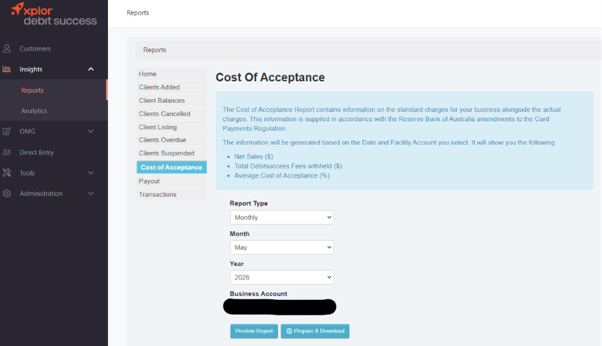
Accessing the report
- Log in to the Debitsuccess Client Self-Service Portal.
- From the menu on the left-hand side of the screen, select Insights.
- Click Reports.
- From the report list, select Cost of Acceptance.
Generating the report
Use the Report Type drop-down menu to choose one of the following options:
- Monthly – View the Cost of Acceptance Report for a specific month.
- End of Financial Year – View the report for the selected financial year.
If you select Monthly, you will also need to choose the reporting month, the reporting year, and the relevant business account or service.
Once all selections have been made, click Preview Report. The report will generate and display at the bottom of the screen for the selected service and reporting period.
Understanding the report
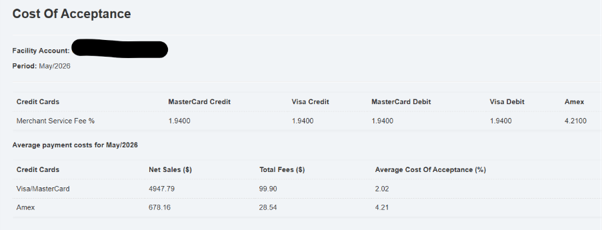
The report provides a breakdown of merchant service fees by card type, including:
- Visa and Mastercard merchant service fee percentage
- American Express (AMEX) merchant service fee percentage
- Average payment cost for each card type during the selected reporting period
- Net sales processed
- Total fees charged
- Average Cost of Acceptance percentage
This information can be used to understand the overall cost of processing card payments and the average merchant fee rate applied across transactions for the selected period.
19. Questions about your configuration?
If you have questions about how these changes apply to your specific payments setup, please contact:
- Your Customer Success Manager, or
- payments.education@xplortechnologies.com
20. Can I continue to surcharge AMEX?
The RBA reforms specifically apply to EFTPOS, Visa and Mastercard — American Express is not a designated network under these reforms, so it isn’t covered by the regulatory ban.
However, American Express will also remove surcharging on its network from 1 October 2026.
21. Can I replace the surcharge with an administration fee or processing fee?
We are unable to provide legal or compliance advice regarding alternative fee structures, however the ACCC has provided guidance on renaming card surcharges.
For more information, please refer to the ACCC’s guidance on card surcharges: ACCC – Card Surcharges
You should seek independent advice regarding any proposed pricing model to ensure it complies with applicable laws and regulations.
The RBA’s reforms are intended to prevent consumers from being charged a separate fee based on their choice of payment method.
22. Will families notice any change when making payments?
Families will continue to make payments through the same payment methods and channels available today.
The primary change is that card payment-related fees can no longer be presented as a separate surcharge for affected payment types.
Any broader pricing decisions remain the responsibility of the service.
23. Does this affect CCS payments or government funding?
No.
The RBA reforms relate to payment surcharges applied to customer payment transactions.
Government subsidies, including CCS payments, are not impacted by these surcharge reforms.
24. What is our current arrangement with you, Debitsuccess?
The fees charged by Debitsuccess are part of your existing commercial agreement and cover:
- Payment processing costs (including card network fees)
- Platform, product and engineering
- Ongoing support and service delivery
These fees remain a cost of operating your payment service, and the regulatory changes do not alter this arrangement.
Previously, where surcharging was enabled, Debitsuccess facilitated the pass-through of these costs to families on your behalf.
25. Do our families need to sign new Direct Debit Request (DDR) forms?
No. The upcoming changes relate to how card payment fees can be managed and do not affect the underlying direct debit authority provided by your families.
Existing Direct Debit Request forms remain valid, and there is no requirement to obtain new ones.
Last updated 7 September 2026